Which doctor should I consult if I suspect arthritis?
As a rule, people first turn to a general practitioner, who, if arthritis is suspected, refers them further to a specialized specialist – a surgeon or rheumatologist. Arthritis in children is treated by a pediatrician or pediatric rheumatologist.
At the consultation, the doctor will conduct a survey and examination, prescribe instrumental and laboratory tests.
Examination
If arthritis is suspected, the doctor will clarify what preceded the pain attack. This will help to understand the cause of the disease. For example, gouty arthritis is usually preceded by overeating, alcohol abuse, and traumatic arthritis is usually preceded by intense physical activity.
During the examination, the doctor will assess the condition of the joints: with arthritis, the affected joint swells, the skin over it may turn red, become hot and tender.
Laboratory research methods
To assess the general condition of the body and determine the cause of the disease, the doctor prescribes a clinical blood test.
If gouty arthritis is suspected, a blood test for uric acid is prescribed.
Joint (synovial) fluid analysis is used to detect uric acid crystals or bacteria.
Immunological studies help in the diagnosis of rheumatoid and post-streptococcal arthritis. The level of specific autoimmune antibodies in the blood, markers of inflammation of the joints, is determined in the course of research.
Also, the doctor may prescribe a blood test for the presence of specific antibodies – markers of systemic autoimmune diseases of the connective tissue.

Instrumental research methods
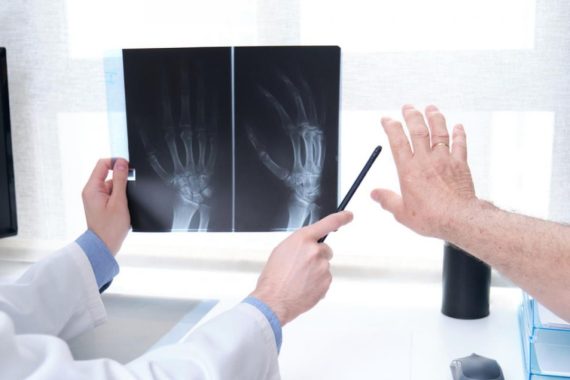
Radiography and computed tomography allow you to assess the condition of the joints and identify deformation or other changes in them. In addition, such studies allow to understand the cause of joint pain.
Ultrasound examination allows to assess the severity of inflammation and identify damage to soft tissues, such as tendons. Often, ultrasound can show signs of gouty arthritis.
Arthritis treatment
Treatment for arthritis depends on the cause of the disease. So, for the treatment of gouty arthritis, drugs that reduce the level of uric acid in the blood are used, and non-steroidal anti-inflammatory drugs and temporary immobilization of the joint help from traumatic arthritis.
Physiotherapy can also help relieve symptoms and speed up recovery. In severe cases, the doctor may prescribe surgical treatment.
Medication treatment of arthritis
To reduce joint pain in any arthritis, drugs from the non-steroidal anti-inflammatory drugs group (NSAIDs) are used. This is the so-called symptomatic therapy – it reduces the manifestations, but does not cure the disease.
The choice of treatment tactics depends on the cause of arthritis and the severity of the disease. For the treatment of autoimmune forms of the disease, antirheumatic drugs are prescribed. They suppress the pathological component of the immune system and slow down the progression of the disease. In addition, the doctor may prescribe hormonal drugs – they quickly reduce inflammation and stiffness of the joints, relieve pain.
Steroid injections into the joint help relieve the symptoms of arthritis, but are used with caution.
In infectious arthritis, antibacterial, antiviral, or antifungal drugs are used.
Physiotherapy and exercise therapy help restore mobility to the joint, as well as strengthen the surrounding muscles.
Supportive therapy
If your arthritis makes it difficult to do your daily activities, your specialist may recommend special bandages that fix the bone, orthopedic insoles, or other devices.
In addition, during the period of remission it is useful to strengthen the musculoskeletal system. For this, aerobic exercises are suitable: brisk walking, swimming or cycling. The duration and intensity of the physical loads must be agreed with the attending physician.
Surgery
If arthritis reaches the final stage, when the joints are severely damaged and unable to perform their function, a doctor may recommend surgical treatment. With the help of surgery, and in some cases joint prosthetics, it is possible to restore the mobility of the limb and relieve pain.
Prognosis and prevention of arthritis
The prognosis for arthritis depends on the type of disease. Osteoarthritis is usually well controlled and may not affect a person’s normal life. Infectious arthritis is completely curable.
Rheumatoid and psoriatic arthritis are chronic diseases that, if left untreated, can eventually lead to severe limitation of joint mobility and disability.
With adequate therapy, 50–70% of patients with juvenile arthritis achieve remission. People with Bekhterev’s disease can also enter a stable remission, in which there is a significant improvement in the condition.
Arthritis prevention
To avoid joint pain, which is usually associated with age-related changes in bones or injuries, it is important to be physically active: the more a person moves, the better the condition of muscles, bones, ligaments and joints.
To maintain physical activity, adults need 150 minutes of moderate-intensity aerobic exercise per week: brisk walking, swimming, cycling, tennis, dancing or rollerblading. Pilates and yoga will help strengthen the muscles.
In addition, gymnastics (tilts of the body, rotation of the joints) helps to avoid the appearance of pain.