De Quervain disease (chronic tenosynovitis, stenosing tendovaginitis, stenosing ligamentitis) is a narrowing of the canal in which the tendons of the thumb pass. It is accompanied by inflammation of the tendon sheaths. It arises as a result of a constant increased load on the hand, often in connection with the performance of professional duties. It usually develops gradually. The course is chronic. The disease is characterized by pain at the base of the first toe and slight local edema. Due to pain, patients have a reduced or lost ability to perform a series of movements involving both the first finger and the entire hand.
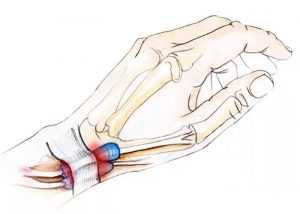
De Quervain disease is a narrowing (stenosis) of the canal in which the tendons of the first finger of the hand are located. The cause of the disease is the constant trauma of the canal when the tendons move in it. As the disease progresses, due to narrowing of the canal, the tendons begin to rub more and more against its walls, inflammation (tendovaginitis) develops in the tendon sheaths, and they swell, leading to even greater damage to the canal during movement and stimulating the further development of stenosis.
The disease develops gradually and is chronic. Women suffer more often than men, the elderly more often than young people. Usually, there is a connection between the disease and the nature of the work or increased load on the hand when performing household duties.
Causes of de Quervain disease
In modern traumatology and orthopedics, the prevailing opinion is that de Quervain disease is predominantly of a professional nature.
The first finger is the most active. It participates in almost all small movements of the hand and plays an essential role in the performance of a number of larger operations, for example, fixing objects or instruments. With the constant performance of movements associated with prolonged tension of the thumb and deviation of the hand towards the little finger, the already considerable load on the canal and tendons increases even more. Favorable conditions are created for the development of stenosis and concomitant inflammation.
The disease, as a rule, is observed in pianists, housekeepers, milkmaids, laundresses, seamstresses, locksmiths, furriers, stonecutters, field workers, painters, winders, ironers, etc. However, this pathology can also be detected in non-working women. In the latter case, the development of the disease is associated with household chores and carrying small children in their arms.
Symptoms of de Quervain disease
The disease develops gradually. Usually, people come to their appointment for the first time a few days or weeks after symptoms start. In about 7% of cases, there is an acute onset associated with a previous hand injury. When collecting an anamnesis of the disease, it turns out that at first patients were worried about pain only with significant extension and abduction of the thumb, as well as with a sharp abduction of the hand towards the little finger. Subsequently, the pain syndrome progresses and occurs even with minor movements.
Patients complain of pain in the lower part of the forearm and the projection of the wrist joint on the side of the thumb. Pain can occur exclusively during movement or be pressing, aching, constant, not disappearing even at rest. Accidental awkward movements may also cause severe pain during sleep. In more than half of the cases, pain radiates downward, along the outer surface of the first finger or upward, along the forearm, elbow joint, and shoulder.
Inspection is necessarily carried out in comparison of both hands – this allows you to accurately identify sometimes not too pronounced, but absolutely characteristic of de Quervain disease on the part of the diseased hand. In the area of the wrist joint from the side of the first finger, a slight or moderate local edema is determined. The anatomical snuffbox is smoothed or not visible due to swelling. The skin over the affected area is not changed; there is no local temperature rise. Rare cases of peeling, redness, and local hyperthermia are caused not by the disease itself, but by self-treatment, which sometimes patients carry out before consulting a doctor.
Palpation reveals soreness in the affected area, reaching a maximum in the projection of the styloid process of the radius. The pressure on the tendon area of the first finger is painless. Just below the styloid process, a dense and smooth formation of a rounded shape is felt – the dorsal ligament, thickened in the canal region.
After examining the affected area, the patient is asked to put his hands with palms down and deflect the hands alternately towards the little finger and thumb. The patient’s hands are almost equally deflected towards the 1st finger. With a deviation towards the little finger, a restriction of movement by 20-30 degrees is revealed in comparison with a healthy hand, and the movement is accompanied by severe soreness.
In addition, the limitation of abduction of the thumb is determined on the sore hand. To identify the symptom, the patient is asked to place the hands on the edge with palms facing each other. During movements, a significant restriction of abduction is noticeable (the difference between the sick and healthy sides is from 40 to 80 degrees). The difference in the extension of the first fingers is not so striking, but it is also visible to the naked eye.
Another study to confirm the diagnosis is the Finkelstein test. The patient presses the thumb to the palm and squeezes it tightly with the rest of the fingers, and then moves the hand towards the little finger. The movement is accompanied by a sharp pain in the affected area. Also, with this disease, a violation of the ability to hold objects with the help of the first finger is revealed. The patient is asked to simultaneously take some objects (for example, pens or matchboxes) I and II with the fingers of both hands. When pulling on the object, pain and weakness are revealed when holding on to the sore side. The diagnosis of de Quervain’s disease is made on the basis of clinical data. Additional research is not required.
Diagnostics
Examination by an orthopedist, taking anamnesis
R-graphy
Ultrasound procedure
Treatment for de Quervain disease
Immobilization of the joint with fixators of the German company Medi.
Load limitation.
Drug treatment
Physiotherapy: Light therapy with the apparatus “Bioptron” (Switzerland), which has a polychromatic incoherent effect, creating a polarized light.
Magnetotherapy on a stationary Italian device “Magnetotherapy PMT QS”.
Ultrasound therapy on an ultrasound device “Sonoplus 490” (Holland) providing deeper penetration of drugs.
Shock-wave therapy on the device “Master plus 100” (Swiss company Storz medical).
If conservative therapy is ineffective, surgical treatment is performed.