Visual acuity is one of the main functions of the eye, examined by an ophthalmologist at the attendance. It can decrease due to refractive errors, eye diseases, and injuries, neurological diseases. Visual acuity means the ability of the eye to see separately two luminous points at the smallest angle of view. Normally, this angle should be 1 min – this visual acuity is taken as 1.0 (unit). Donders proposed a formula for calculating visual acuity: V = d / D, where V is visual acuity, D is the distance at which the elements of a given optotype are visible at an angle of 1 min, and d is at which it is possible to recognize this sign.
The method of examining visual acuity is called visometry.
When carrying out it, it is required to recognize objects called optotypes.
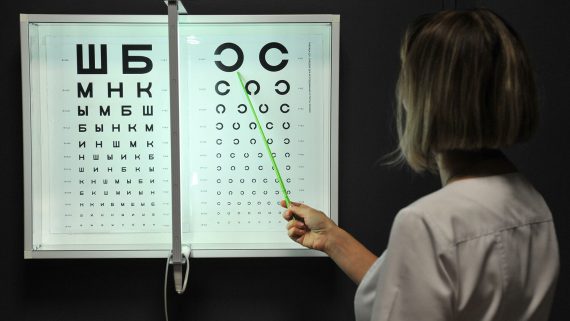
Determination of visual acuity.
In this case, as a rule, special tables are used (presented on the monitor screen or using a special projector). The person being examined may be presented with letters, numbers, rings with breaks, or drawings (for children) for recognition.
Indications for the procedure
As soon as you feel a decrease in visual acuity, you need to see an ophthalmologist and undergo a procedure that will help establish the ratio of vision. In addition to determining visual acuity, visometry is used to detect astigmatism in a patient. myopia or hyperopia.
At the first stage of diagnosis, the doctor determines a person’s visual acuity, if the result obtained needs to be improved, further diagnosis is carried out. As a result, the optimal option is selected, which improves vision by up to one hundred percent.
Given the variety of methods of ophthalmological studies, it should be noted that visometry refers to the initial stage of diagnosis and, if necessary, can be supplemented with more complex examinations using medical equipment or medicines.