Diagnosis of strabismus
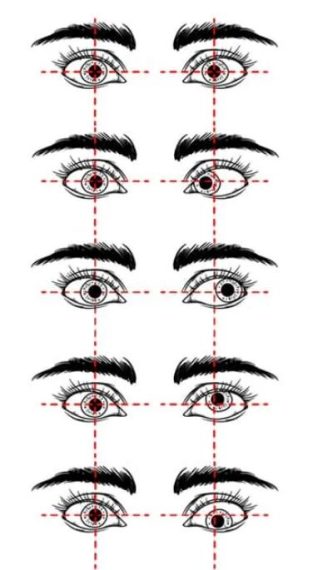 Testing for strabismus will require extensive ophthalmic examinations, biometric examinations, examination of the structures of the eye, and refraction examination.
When collecting an anamnesis, the time of onset of strabismus and its relationship with past diseases and injuries is clarified. During an external examination, the involuntary position of the head (with paralysis), the symmetry of the face and orbits, the location of the eyeballs (enophthalmos, exophthalmos) are assessed.
After that, visual acuity is checked without correction and with the help of test lenses. Clinical refraction is checked to determine the optimal correction using skiascopy and computerized refractometry. If, against the background of cycloplegia, strabismus disappears or decreases, this indicates that the pathology has an accommodative character. The anterior segments of the eye, the transparent medium and the fundus of the eye are examined using biomicroscopy, ophthalmoscopy.
To check binocular vision, a test is performed with the eye closed: the squinting eye deviates to the side; the ability to merge (the ability to combine images) is assessed using the synoptophoric apparatus. The measurement of the angle of strabismus (the magnitude of the deviation of strabismus), the study of convergence, and the determination of the magnitude of accommodation are carried out.
If paralytic strabismus is detected, a consultation with a neurologist and an additional neurological examination (electromyography, electroanurography, evoked potentials, EEG, etc.) are indicated.
Treatment of strabismus
The main goal of treatment for concomitant strabismus is the restoration of binocular vision, in which the asymmetry of the eye is eliminated and visual functions are normalized. Measures may include optical correction, pleoptic-orthoptic treatment, surgical correction of strabismus, pre- and post-operative orthoptodiplotic treatment.
In the process of optical correction of strabismus, it is supposed to restore the lumen of the eye, as well as normalize the ratio of accommodation and convergence. For this purpose, glasses or contact lenses are selected. With accommodative strabismus, this will be enough to eliminate heterotropia and restore binocular vision. Meanwhile, spectacle or contact correction of ametropia is necessary for any of its forms.
Pleoptic treatment is indicated to increase the visual load of the slanting eye in amblyopia. For this purpose, fixing occlusion of the eye, penalization, hardware stimulation of the amblyopic eye (Amblyocor, Amblyopanorama, software-computer treatment, accommodative training, electrooculostimulation, laser stimulation, magnetostimulation, photostimulation, vacuum ophthalmic massage) can be used. The orthooptic phase of strabismus treatment will focus on restoring the coordinated binocular function of both eyes. For this, a synoptic apparatus (Synoptophore) and computer programs are used.
At the final stage of strabismus treatment, diploptic treatment is carried out, which will be aimed at the development of binocular vision in natural conditions (exercises with bagolini lenses, prisms); to improve eye mobility, gymnastics, classes on a convergent simulator are prescribed.
If the effect of conservative treatment is not observed within 1-1.5 years, surgical treatment of strabismus is possible. It is optimal to carry out the correction of strabismus with the help of surgery at the age of 3-5 years. In ophthalmology, the reduction or elimination of the angle of inclination is carried out in stages. Two types of operations are used to correct strabismus: weakening and strengthening the function of the muscles that move the eye. Weakening of muscle control is achieved by transplanting the muscle (recession) or cutting the tendon, and increasing the muscle effect is achieved by resection (shortening).
Orthoptic and diploptic treatment is indicated to correct residual deviation before and after strabismus surgery. The success of surgical correction of strabismus is 80-90%. Complications of surgical intervention can be hypercorrection and insufficient acceleration of blood circulation; in rare cases, infection, bleeding, loss of vision.
The criteria for the treatment of strabismus are the symmetry of the location of the eyes, the stability of binocular vision and high visual acuity.
Botox treatment is currently being tested.
Forecast and prevention of strabismus
Strabismus treatment should be started as early as possible so that visual function is sufficiently restored until the child starts school. In almost all cases, strabismus requires constant, consistent and long-term complex treatment. Late initiation of strabismus correction or improper correction can lead to irreversible visual impairment.
Accommodative strabismus is most successfully corrected; the prognosis for the restoration of full-fledged visual function in case of late detection of paralytic strabismus is negative.
For the prevention of strabismus, regular examination of children by an ophthalmologist, timely optical correction of ametropia is necessary.
For the prevention of strabismus, regular examination of children by an ophthalmologist, timely optical correction of ametropia, compliance with the requirements of visual hygiene, and limiting visual stress are necessary. Early detection and treatment of any eye diseases, infections, prevention of skull injuries is necessary. During pregnancy, factors that adversely affect the fetus should be avoided.